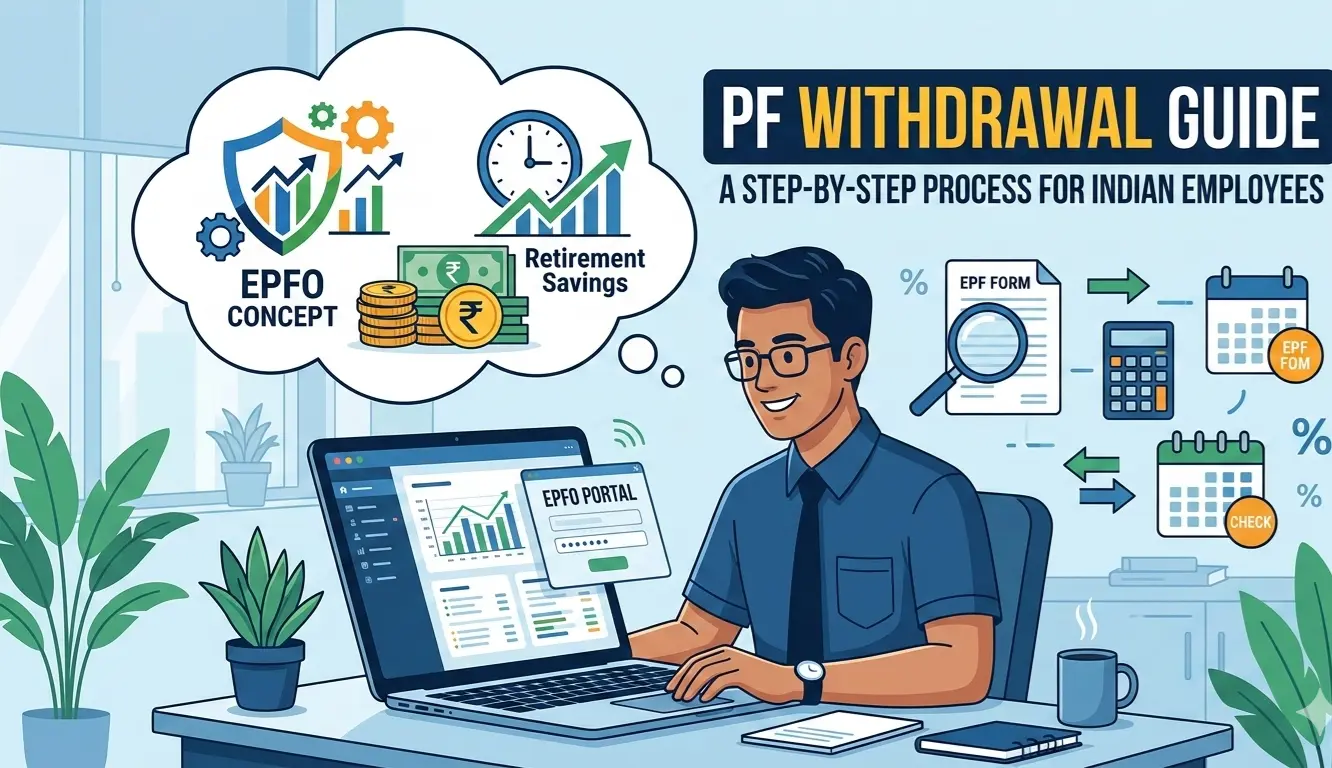

In this article you will learn everything about PF withdrawal, including eligibility, rules, tax, and how to withdraw PF amount online, step by step guide to check PF withdrawal status.
Table of Contents
PF withdrawal refers to the process through which employees withdraw money from their employee provident fund account. The Provident Fund scheme is a long term retirement savings system designed for salaried employees in India. Under this scheme, both the employee and employer contribute a portion of the employee’s salary every month, which accumulates over time with interest.
The scheme is regulated by the Employees’ provident fund organisation, which manages PF accounts and ensures that employees receive their savings securely, the main objective of the provident fund is to help employees build a retirement corpus, however, employees can withdraw their PF amount in certain situations such as retirement, unemployment, medical emergencies, or major life events.
Types of PF withdrawal
PF withdrawal can be broadly classified into full withdrawal and partial withdrawal, full withdrawal allows employees to withdraw the entire PF balance, including employee contributions, employer contributions, and accumulated interest, this usually happens when an employee retires at the age of 58 or remains unemployed for more than two months.
Partial PF withdrawal allows employees to withdraw only a portion of their PF balance while keeping the account active, partial withdrawals are generally allowed for specific purposes such as medical treatment, marriage, higher education, home purchase, or home loan repayment. These withdrawals are subject to certain eligibility conditions and limits to ensure that employees do not exhaust their retirement savings too early.
Read More:-
best to teach kids about money
What happened if you miss a EMI
Personal loan without CIBIL score
How PF contribution works
To understand PF withdrawal, it is important to know how contributions are made to the PF account, under the EPF scheme, employees contribute 12% of their basic salary and dearness allowance every month to their PF account. The employer also contributes an equal percentage, but the employer’s contribution is divided between the EPF and the employee pension scheme.
Over time, these contributions accumulate along with interest declared annually by the employees provident fund organisation, because of compound interest and regular monthly contributions, the PF balance grows steadily and becomes an important financial resource for employees during retirement or emergencies.
How can I withdraw my PF amount?
Employees can withdraw their PF amount through both offline and online methods, but the online method is faster and more convenient, the withdrawal process is managed through the EPFO portal provided by the Employees provident fund organisation.
To withdraw PF online, employees must log in to the EPFO member portal using their universal account number and password, after logging in, they can select the claim option under online services and submit the required withdrawal form such as Form 31 for partial withdrawal or Form 19 for final settlement, once the claim is submitted and verified, the PF amount is usually transferred directly to the employee’s bank account within 7 to 15 working days.
Can I withdraw 100% of PF?
Yes, employees can withdraw 100% of their PF balance, but only under specific conditions, full PF withdrawal is allowed when an employee reaches the retirement age of 58 years or remains unemployed for more than two months, in these situations, employees are allowed to withdraw the entire PF amount along with accumulated interest.I
n cases of unemployment, employees can withdraw 75% of their PF balance after one month of unemployment, while the remaining 25% can be withdrawn after two months, this rule is designed to provide financial support to employees while also encouraging them to preserve their retirement savings if they find a new job quickly.
How to check PF withdrawal online?
After submitting a PF withdrawal request, employees can easily check the status of their claim online. The EPFO provides a digital tracking system that allows employees to monitor their PF withdrawal status.
To check the claim status, employees need to visit the EPFO website and access the Track Claim Status section, by entering their UAN and required details, they can see the current status of their withdrawal request, the status may show stages such as claim submitted, under process, approved, or payment sent to the bank. This online tracking system helps employees stay informed about their PF withdrawal progress.
PF withdrawal rules and eligibility
PF withdrawal is governed by specific rules set by the employees provident fund organisation, these rules ensure that PF funds are primarily used for retirement and essential financial needs, employees can withdraw PF for purposes such as medical treatment, marriage, education, or housing, but some of these withdrawals require a minimum number of years of service.
For example, withdrawals for marriage or education generally require at least seven years of service, while withdrawals for home purchase may require five years of service, medical withdrawals, however, can be made without any minimum service requirement.
Tax rules on PF withdrawal
Taxation is an important factor to consider when making a PF withdrawal, if an employee withdraws PF before completing five years of continuous service, the withdrawal may become taxable and TDS may be deducted depending on the amount withdrawn.
However, if the PF withdrawal is made after five years of continuous service, the entire amount becomes tax free, this tax benefit is one of the major advantages of the provident fund scheme and encourages employees to maintain long term contributions.
Importance of managing PF funds wisely
Although PF withdrawal provides financial support during emergencies, employees should avoid frequent withdrawals whenever possible, the provident fund is primarily designed as a retirement savings scheme, and withdrawing funds too early can reduce the final retirement corpus, by allowing PF savings to grow with compound interest and continuous contributions, employees can build a strong financial foundation for the future. Many financial experts recommend transferring PF accounts when changing jobs instead of withdrawing the balance.
Conclusion
PF withdrawal is an essential financial facility that allows employees to access their provident fund savings when needed, whether it is for retirement, unemployment, medical emergencies, or major life events, understanding the rules and process of PF withdrawal helps employees manage their finances more effectively.
With improved digital services introduced by the employees provident fund organisation, the PF withdrawal process has become faster, easier, and more transparent, mployees can now submit claims online and track their withdrawal status conveniently.
By using PF funds wisely and avoiding unnecessary withdrawals, employees can ensure long term financial security and build a strong retirement corpus.
FAQ
Q1. How can I withdraw my PF amount?
Ans. You can withdraw your PF amount online through the EPFO portal by logging in with your UAN, selecting the claim option, and submitting the PF withdrawal form.
Q2. Can I withdraw 100% of PF?
Ans. Yes, you can withdraw 100% of your PF balance after retirement at 58 years or if you remain unemployed for more than two months.
Q3. How to check PF withdrawal online?
Ans. You can check PF withdrawal status by visiting the EPFO website, entering your UAN, and using the claim status tracking feature.
Q4. How long does PF withdrawal take?
Ans. PF withdrawal usually takes 7–15 working days after the claim is submitted and verified.
Q5. Is PF withdrawal taxable?
Ans. PF withdrawal is tax free if the employee has completed five years of continuous service.