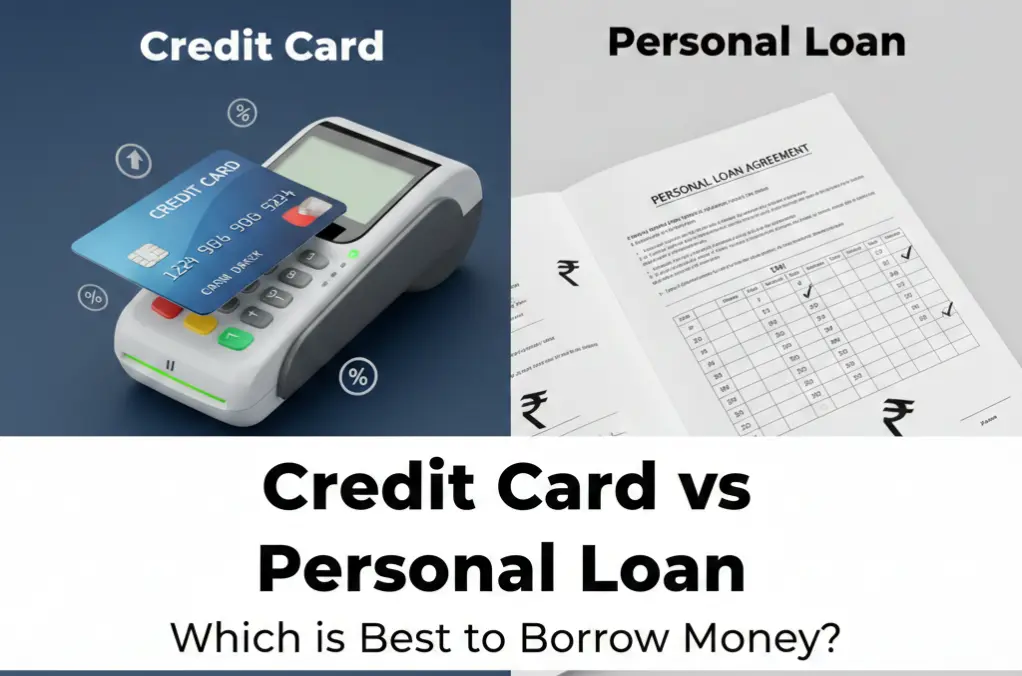

Credit card vs personal loan comparison, Learn interest rate comparison, EMI vs revolving credit, impact on credit score, and the best way to borrow money for your needs.
When it comes to managing expenses or emergencies, people often get confused between a credit card or personal loan. Both are popular borrowing options and both are a type of unsecured loan, but their cost, flexibility, and repayment style are very different.
Understanding the real difference between credit card vs personal loan can help you choose the best way to borrow money without falling into a debt trap.
How to improve CIBIL Score-Read More
Our Finance Calculator-Try Now
Personal Loan without CIBIL Score-Read More
What Is a Credit Card?
A credit card allows you to borrow money up to a fixed limit and repay it monthly. It follows a revolving credit system, meaning you can keep using it as long as you stay within the limit.
This is a key point in the EMI vs revolving credit comparison. You can either pay the full bill to avoid interest or pay the minimum due and carry forward the balance with high interest.
What Is a Personal Loan?
A personal loan gives you a fixed amount of money in one go, which you repay in monthly EMIs over a fixed period. In the loan vs credit card comparison, this makes personal loans more structured and predictable.
Personal loans are often used for weddings, medical expenses, travel, or debt consolidation.
Credit Card vs Personal Loan – Finance Comparison
| Type Loan | Revolving credit | Fixed EMI |
| Interest Rate | 30% to 45% per year | 10% to 24% per year |
| Repayment | Minimum or full payment | Fixed monthly EMIs |
| Borrowing Limit | Usually lower | Higher loan amount |
This interest rate comparison clearly shows that personal loans are much cheaper for large amounts.
Which Is the Best Way to Borrow Money?
If you need money for a short time and can repay quickly, a credit card is convenient. However, if you carry the balance, it becomes expensive.
If you need a large amount and want affordable monthly payments, a personal loan is the best way to borrow money because of its lower interest and predictable EMIs.
EMI vs Revolving Credit – Which Is Better?
In the EMI vs revolving credit model, personal loans are easier to manage because you know exactly how much you must pay every month.
Credit cards can become risky if you only pay the minimum due, as interest keeps increasing.
Impact on Credit Score
Both options affect your credit score. Using a credit card responsibly helps maintain low credit utilization, while personal loan EMIs build strong repayment history.
In a personal loan vs credit card comparison, both can improve your credit score if paid on time.
Which Borrowing Option Should You Choose?
Choose a credit card for:
- Small purchases
- Short-term spending
- Emergency expenses you can repay soon
Choose a personal loan for:
- Large expenses
- Lower interest costs
- Stable EMI planning
This makes the credit card vs personal loan decision simple and practical.
Final Verdict – Credit Card or Personal Loan?
In the long run a personal loan is more affordable for large or long term borrowing, while a credit card is better for short term convenience. Your choice should depend on how much you need and how fast you can repay. Understanding this finance comparison helps you avoid unnecessary interest and choose the smartest borrowing option.
Frequently Asked Questions – Credit Card vs Personal Loan
Q1. Is a credit card or personal loan better for emergencies?
Ans. A credit card is better for short term emergencies because it offers instant access and an interest free period. However, for large emergencies, a personal loan is more affordable due to lower interest rates.
Q2. Which has lower interest – credit card or personal loan?
Ans. A personal loan has much lower interest than a credit card. Credit cards usually charge 30% to 45% annually, while personal loans typically range between 10% and 24%.
Q3. Can I convert credit card spending into EMI?
Ans. Yes, many banks allow credit card purchases to be converted into EMIs. However, even EMI conversions on credit cards usually cost more than a personal loan.
Q4. Does a personal loan affect credit score more than a credit card?
Ans. Both affect your credit score equally. Timely EMI payments improve your score, while missed payments or high credit card usage can reduce it.
Q5. Which is better for large expenses – credit card or personal loan?
Ans. A personal loan is better for large expenses because it offers lower interest, fixed EMIs, and predictable repayment.
Q6. Is a credit card considered a loan?
Ans. Yes, a credit card is a type of unsecured revolving loan, but it works differently from a personal loan, which has fixed EMIs and a defined repayment period.
Q7. What is the best way to borrow money without high interest?
Ans. For small short-term needs, use a credit card and pay in full. For large or long term needs, a personal loan is the best way to borrow money with lower interest.
Q8. Can I have both a credit card and a personal loan?
Ans. Yes. Using both responsibly improves your credit mix and helps build a strong credit profile.